
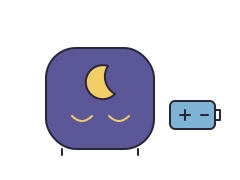
- Bedtimethe moon lit up
- Wake-up timethe moon goes out and the sun lights up
As an Amazon Associate I earn from qualifying purchases.
The tradeoff: It has one wake-up time for every day, with no nap or weekend time, and the big red switch goes on every evening and off every morning.
From Pabobo’s own pages and manual: the sources.
Set this clock up
- Hold SET on the back for more than 3 seconds, until the padlock leaves the screen. If you leave the buttons alone, the lock comes back by itself.
- The hour now flashes: first set the wake-up (alarm) time with the arrow button, pressing SET to go on to the minutes and to confirm. Then set the current time the same way, or press SET twice to skip it. Hold the arrow and SET together to switch between 12- and 24-hour time.
- Set the hands with the dial on the back. They run separately from the screen, and the wake-up time follows the screen, so check now and then that the two still match, and when the clocks change, turn the hands as well as the screen time. The arrow only counts forward: to put the screen back an hour in October, hold it down until the hour comes round.
- Pick the alarm sound with the slider, or slide it fully left (OFF) for a silent wake-up. Switch on the wake-up light with the button behind it: at the wake-up time the moon goes out and the sun lights up.
- Turn the big red switch to ON in the evening and OFF in the morning; it starts and stops everything you set. When the alarm sounds, the mushroom button pauses it for 3 minutes; at night the same button lights the face and the screen for a few seconds.
Pabobo says to keep the clock out of reach of children under 3 (its cord is a strangulation risk), to use only the adapter it recommends, and recommends the clock from age 5.
Check the age warning and whether your child is ready separately, and see how to set an OK-to-wake clock for other clocks.
Setup and everyday controls
You set it with the buttons on the clock. No app is needed, and no account.
- How you set it
- Set on the clock
- Buttons on the clock
- Yes
- Change it from your phone
- No
- Account needed
- No
When grandma, a sitter or the other parent sets it
Anyone can use the buttons on the clock; there is no app to share. Show the next grown-up the lock (hold SET for 3 seconds) and the big red switch, which starts each night.
Schedules, light and sound
You switch the mode on at the clock.
What you can schedule on this clock
- Bedtime light at a set timeNo
- Wake-up light at a set timeYes
- Nap timerNo
- Different weekend timesNo
 Wake-up light at a set time
- Yes
- Bedtime light at a set time
- No
 Nap timer
- No
- Nap wake-up time
- No
 Weekday and weekend times
- No
 Several light or sound changes a night
- No
- Start it by hand
- Yes
- Silent wake-up light
- Yes
 Alarm sound
- Yes
- Sound machine
- No
- Shows the time
- Yes
- Child lock
- Yes
Features the maker’s manual doesn’t mention aren’t listed here, so the clock matcher won’t suggest this clock for them.
A nap timer and a nap wake-up time work differently. The planner keeps them separate.
Clocks changing, or an early riser? Move the wake-up light in small steps with the clock-change planner.
Without Wi-Fi or a phone
It has no app and needs no Wi-Fi: you set and change everything on the clock, and switch its night mode on each evening.
Power, and what happens in a power cut
Plugged in
Runs on battery · Mains adapter (included), or 2 AA batteries (not included)
With 2 AA batteries in (not included) it keeps running in a power cut; Pabobo says they last about a month with the night light on 12 hours a day.
- Runs on battery?
- Runs on battery
- Power connection
- Mains adapter (included), or 2 AA batteries (not included)
- Battery life
- About a month if the night light is on 12 hours a day, Pabobo says
See why a battery that keeps the settings is different from one that keeps the light on.
Subscription and included parts
No subscription: everything works on the clock.
In the box
- Kid’Sleep Clock
- Mains adapter
When your child outgrows the light
It is already a first alarm clock: your child practices the time on the analog face and checks it on the digital screen. The alarm and the sun share one wake-up time, so switch the sound off for days without school. When to move on to a kids’ alarm clock.
Check it in your home
While you can still return it, try the buttons you will actually use. These are checks for you to make; we have not tested this clock.
- Find how to change the times and switch the wake-up light on, then check it shows the light and sound you chose.
- Check the brightness, the volume and where the clock stands, using the maker’s placement advice. Check what the lock stops and which buttons still work.
- Use the clock’s own preview or test, if it has one, rather than unplugging it or resetting it to see what happens.
- Show the other parent, a grandparent or the sitter the buttons. Read what to do after a power cut before you need it.
Agree on what the light means and what to do if it does not come on, then keep the manual or the maker’s help page with your plan.
Show your child what this clock’s light means, and leave a note for the sitter.
If the light does not come on, check the time, the mode and the power before you reset the clock.
Questions about the Pabobo Kid’Sleep Clock
Does the Pabobo Kid’Sleep Clock need an app?
No. You set it with the buttons on the clock, and no account or Wi-Fi is needed. App or buttons? →
What does my child see on the Pabobo Kid’Sleep Clock?
Bedtime: the moon lit up. Wake-up time: the moon goes out and the sun lights up. See the drawing →
What happens to the Pabobo Kid’Sleep Clock in a power cut?
Keeps running on its battery. With 2 AA batteries in (not included) it keeps running in a power cut; Pabobo says they last about a month with the night light on 12 hours a day. Battery or memory backup? →
Can the Pabobo Kid’Sleep Clock do naps?
No. Its manual describes no nap timer and no separate nap wake-up time. Nap timers vs nap wake-up times →
Can I set a different time for weekends?
No. It has one wake-up time for every day, so change it on Friday night if you want a later weekend. Plan a new wake-up time →
Does the Pabobo Kid’Sleep Clock have an alarm?
Yes. It is built as a child’s first alarm clock: three sounds (birdsong, a train or a cuckoo) whose volume rises, and a mushroom button that snoozes for 3 minutes. The alarm and the sun share the one wake-up time. Kids alarm clocks →
Can grandma or a sitter change it?
Yes, with the buttons on the clock; nobody needs an app or an account. Sharing a clock →
The maker’s pages
Details can differ between versions and countries. Dates show when we last checked something that changes, like stock or a recall. Every source we use
- Pabobo: Kid’Sleep Clock, product page · checked on 17 October 2026
- Pabobo: Kid’Sleep Clock instructions, May 2025 (French and English)